
VAPEDEMIC: Forces behind the vape industry’s appeal to young Filipinos

Jorland Salando, a former traditional smoker, uses his disposable vape in a dimly lit area in St. Mesa Manila.
Vapes or e-cigarettes were brought to the market in 2004 and gained popularity in the Philippines, particularly among teenagers in 2017. It appeals to the youth because it offers a variety of flavors and it is believed to be a safer alternative to traditional smoking.
Rapidly growing vape industry

The e-cigarette and vape market in the Philippines is undeniably successful, as revealed in a study by the Grand View Research, where the market is found to have a current value of ₱ 7.2 billion. If the market continues to flourish with its current compound annual growth rate of 18.7%, it is predicted to be worth ₱20.2 billion by 2030.
Prominent three key companies namely Phillip Morris International Inc., British American Tobacco Plc, and Altria Group Inc., make up most of the huge international market, all of which earn billions of dollars per year. Based on the Tobacco Transformation Index 2022, these companies earned $8.7 billion, $4.7 billion, and $2.7 billion respectively.
Locally, major e-cigarette and vape companies are Altria Group Inc., British American Tobacco plc, Geekvape, Imperial Brands plc, Japan Tobacco Inc., Juul Labs, Inc., Philip Morris International Inc., RELX International Enterprise HK Limited, Shenzhen Nevoks Technology Co., Ltd (Nevoks), and Voopoo.
Physical vape retailers around Manila

The Dade Vape Shop operates in Old Sta. Mesa street, beside the Newton Plaza.
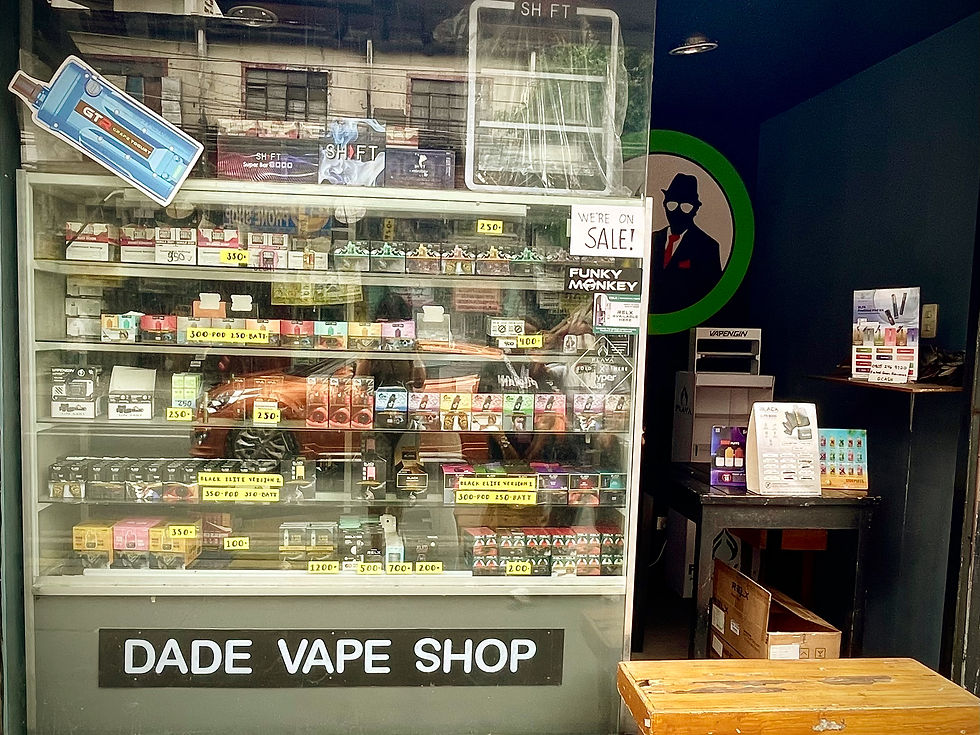
The Dade Vape Shop offers disposable, pen type, and mod type vapes.

Products' packaging from the Dade Vape Shop comes with a warning sign about the addictive nature of nicotine in vapes.
The Dade Vape Shop operates in Old Sta. Mesa street, beside the Newton Plaza.
“Kumikita itong business na ‘to around ₱25-30,000 daily. Maximum namin is ₱35-40,000 in just one day,” Elijah Gomez, the seller of Dade Vape Shop shared.
Gomez said that the shop earns ₱15,000 in a day, at the lowest.
According to Gomez, their supplies are directly sourced from official brands, which distribute their supply to partnered shops on a scheduled basis. For instance, the brand Black Elite supplies Dade Vape Shop every three to four weeks
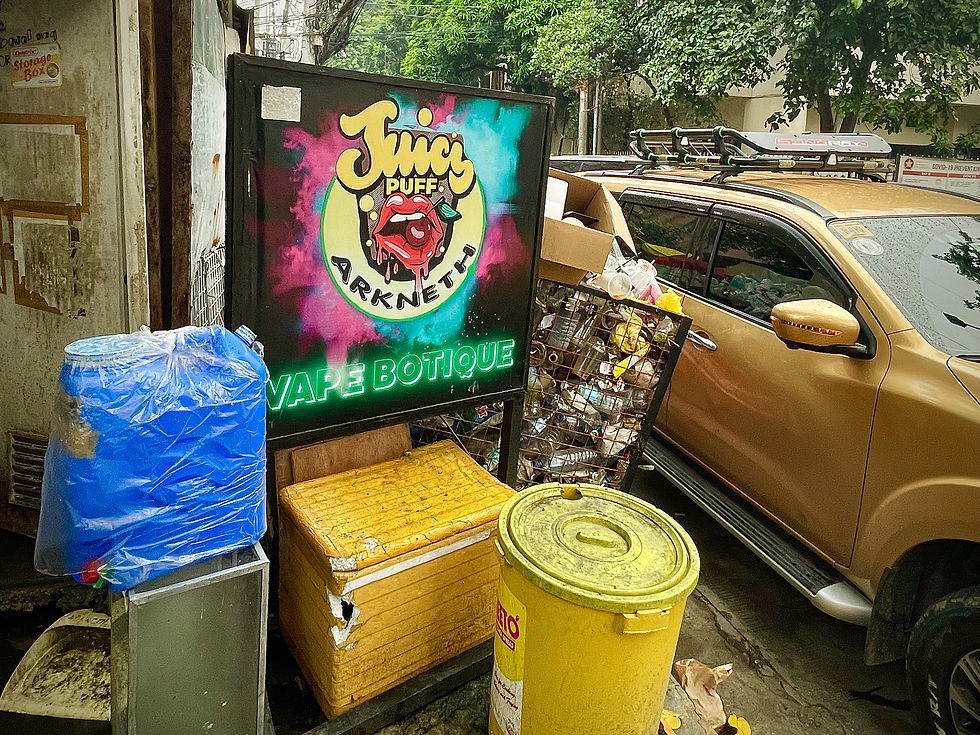
The Juicy Puff Arkneth Vape Botique is located across the Polytechnic University of the Philippines - College of Engineering and Architecture building.

The Juicy Puff Arkneth Vape Botique sells vape products from brands like Black Elite, Black Sheep, and Greek.

The NO ID, NO VAPE, NO MINORS ALLOWED warning sign is posted on the wall of the Juicy Puff Arkneth Vape Botique.
The Juicy Puff Arkneth Vape Botique is located across the Polytechnic University of the Philippines - College of Engineering and Architecture building.
Wilbert Cataytay, on the other hand, does not have direct suppliers and gets his vape products at a high cost. He spent ₱50,000 for the capital of his small shop named Juicy Puff Arkneth Botique.
Cataytay’s products range in price from ₱300 to ₱700. As a small shop, his earnings are relatively lower and he uses his income to support his family’s sari-sari store and his son's educational expenses.
His shop is located directly across from the Engineering and Architecture building of Polytechnic University of the Philippines, Sta. Mesa, Manila. This proximity could pose an issue, as vaping is prohibited inside university premises by law.
Section 15 of the Republic Act No. 11900, also known as the Vape Law, states that the use of Vaporized Nicotine and Non-Nicotine Products shall be prohibited in all indoor public places except in DVAs, or in point-of-sale establishments for purposes of conducting product demonstrations.
“Sabi (ng DTI), hindi naman daw kita (yung tindahan ko), hindi tulad nung mga nadadaanan sa mga highway,” Cataytay explained.
Meanwhile, the Dade Vape Shop is located near Sacred Heart Of Jesus Catholic School—an integrated school. The law also prohibits the sale of vape products within a 100-meter radius of a school. Although the seller refused that the store is within a school zone, a Google Maps search shows it is only 88 meters from the school, where many underage students study.
Section 9 of the same law prohibits the sale, promotion, advertising, and product demonstration of vape products within one hundred (100) meters from any point of the perimeter of a school, playground or other facility frequented particularly by minors shall be prohibited.
Both shops asserted that they do not sell their products to minors.
Online vape retailer

Leonardo’s Facebook page named MAJA VAPE SHOP has 18 likes and 36 followers.
_JPG.jpg)
Leonardo sells his products by posting them on his Facebook account.
Aside from physical shops, vape products are also distributed through online retailers. John Leonardo has been an online vape seller for over a year. He posts and sells his products on social media platforms such as Facebook, Instagram, and TikTok on his main account.
He also utilizes his Facebook page named MAJA VAPE SHOP.
Although Leonardo’s buyers are mostly adults, he shared that there are times when teenagers attempt to buy vape products from him but he refuses to sell them. “Tinatanong ko yung age. Nanghihingi na rin kami ng ID para sure.”
Leonardo offers vape brands like Shift, Cigbay, Greek Barrel, and Flava. He revealed in an online interview that he earned ₱5,000 in two weeks by selling 20 to 30 pieces of vape products to his buyers.
“Sa una mahirap [magbenta] pero ‘pag tumagal-tagal na at alam mo na kung paano mag-market, magiging mas madali na lang sayo.”
Leonardo markets his products by providing free delivery services to those who reside near his house. For customers located farther away, he uses the Lalamove app to deliver the products.
“But when I asked around, you know what I discovered? Kids don't buy vapes at stores. You know where they buy them? Online.” – Department of Health secretary Dr. Teodoro Herbosa.
The popularity of vape products in the Philippine market extends to e-commerce platforms, where buyers can place orders and have them delivered to their doorsteps without difficulty.
Based on the previously mentioned market size report by the Grand View Research, online vape shops are encouraging customers to buy e-cigarettes online. The smaller packaging size of e-cigarettes results in lower shipping rates, making them more appealing to buyers.
Furthermore, anyone can now buy a disposable pod for as low as ₱59 from supposed online vape shops with various flavors such as strawberry donut, apple peach, and banana ice.
Compared to the minimum price of vape products in physical vape stores, the prices in online stores are substantially lower. These vape products are also available on the most well-known e-commerce sites in the Philippines, including Shopee, Lazada, and TikTok.
The online ordering process for RELX vape items on a RELX website is shown in the screenshots below. To view their page, the buyer will first need to sign into their Google account. To confirm that they are of legal age, the website will also request their birthdate. After completing these steps, the buyer will be able to select their desired vape product and purchase it from the website.
Vape products on e-commerce platforms
Ordering process on online websites
.png)


Like the RELX website, most official websites of vape brands do not require identity verification, contrary to the physical vape shops, making it more convenient for young Filipinos to acquire vape products anonymously.
Proximity and appeal to youth
.png)
A study conducted by the Institute for Global Tobacco Control (IGTC) discovered that there are 2,146 retailers of cigarettes, e-cigarettes, and Heated Tobacco Products (HTPs) within a 100-meter radius of 276 schools. The study found 2,070 cigarette retailers, 43 e-cigarette retailers, and 33 HTP retailers—despite laws and regulations that prohibit merchandise of tobacco and nicotine products within school zones.

Furthermore, the same study found that Filipino youth are targeted through e-cigarette product displays and advertising. Almost all (98 percent) of e-cigarette retailers used flavored e-cigarettes as a marketing tactic to entice young customers. Product displays is the second most observed marketing tactic used by 78% of retailers. Other marketing tactics used to target young customers are power walls (31 %), indoor ads (24 %), outdoor ads (21 %), ads at children's eye level (11 %), promotions (5 %), and displays near snacks (5 %).
In relation to the Philippine Pediatric Society's 2021 data, the top three reasons for using vapes among 13-15 year olds are: online accessibility (32%), variety of flavors (22%), and the notion that e-cigarettes are safer than tobacco (17%).
Vape epidemic among Filipino youth
.png)
According to the World Health Organization (WHO), 180,000 Filipino adults were reported to be using vapes, while a significantly larger number of Filipino youths, 360,000, had tried vaping. This suggests that vaping was notably more prevalent among younger individuals compared to adults in 2015.
.png)
In 2022, medical organizations, the Department of Health, and the Department of Education (DepEd) vehemently opposed the then-Vape Bill as it encourages children to find vape products appealing, and reduced the minimum age for purchasing vape products from 21 to 18 years old.
The DepEd records show that in the AY of 2020-2021 alone, senior high school students aged 18-20 make up a population of 1.1 million while students aged 18 in the basic education sector are 870,000 in total. Medical organizations and the said agencies were concerned that this significant number of students would be exposed to e-cigarettes and vape products if the bill were passed. Despite these concerns, the Vape Bill was passed into law in the latter half of 2022.

Moreover, findings of the 2019 Global Youth Tobacco Survey (GYTS) revealed that e-cigarette usage is far more prevalent than the use of any other tobacco product among Filipino students between the ages of 13 and 15.
More specifically, the study found that one in seven students (14.1%) who were between the ages of 13 and 15 admitted to smoking e-cigarettes at the moment, while one in four students (24.5%) in the same age group claimed that they had tried e-cigarettes before. However, 12.5 percent of students, or one in every 8 of them, currently use tobacco products.
The study included over 6,000 student respondents, in grades level seven to ten who were of the same age, showed how easy it is for them to purchase e-cigarettes despite their young age.
“These alarming figures should serve as a wake-up call for our senators to reject the bill easing e-cigarette regulation. The wide prevalence of use of e-cigs as revealed by the GYTS should be enough reason for our senators to recalibrate their approach on the E-Cigs Bill and consider the health hazards these products pose,” said Romeo Dongeto of Child Rights Network (CRN).
“Nagsimula po akong mag-vape noong 14 years old ako. Tapos ‘yung mga binibili ko pong vape noon ay madalas Black Elite. Iba-iba lang yung flavors,” Russel Lorenzo, a 15-year-old student from Esteban Abada High School recalled his first experience with vape products.
“Lychee po talaga yung nagustuhan kong flavor. Na-try ko na rin yung strawberry and blueberry,” he added.
Russel’s first disposable vape product was from Black Elite. It cost him ₱300, while his second vape purchase was ₱500 from a brand named Romeo.
Russel first learned about vape goods from his friends, who were also relatively young. However, to purchase vape products, he asks help from his other friends who are of legal age.
“May mga kaibigan po akong matatanda, 18 years old na sila. Pinapabili ko lang sa kanila ‘yung vape tapos ibinibigay na lang nila sa ‘kin kapag nasa labas na sila ng shop,” Russel stated.
When asked what drove him and other youths to buy and use vape items while being prohibited, Russel said that the flavors in vape products are quite enjoyable.
“Hindi mo na po kasi maiiwasan [gumamit ng vape] kapag natikman mo na.”
Just last week, Russel purchased another disposable vape product and consumed its 8000 puffs.
"Kapag may pera uli ako, bibili agad ako."
Just like Russel, Angelo Franco, a 16-year-old student from Marilao, Bulacan have first seen vape products from his friends. “Nakikita ko silang gumagamit, nainggit din ako kaya sinubukan ko.”
Angelo’s monthly cost for purchasing vape products ranges from ₱600 to ₱700.
“Bukod sa impluwensya ng kaibigan, mabenta ang vape ngayon lalo na sa kabataan dahil marami silang nakikitang gumagamit nito,” Angelo said when asked why e-cigarettes are currently popular among the youth.
He added that the youth believes that using vape products will make them look cooler.
“Noong patagal na ‘ko nang patagal sa pag-va-vape, nararamdaman ko na medyo sumisikip na dibdib ko pero nawawala rin siya kapag umiinom ako ng tubig,” said Maria Mercado, a 14-year-old student from Pampanga who began using vapes at the age of 13.
“Sumisikip lang talaga dibdib ko ‘pag nasobrahan ako sa paghihipak,” she added.
According to Maria, she was not really interested with vape products at first.
“Actually na influence lang ako sa ibang nag-va-vape. Hindi naman talaga ako interesado noon pero nung na-try ko, ayun nagustuhan ko. Hindi ko na matigilan.”
“Bili na ‘ko nang bili ng vape hanggang maubos pera ko sa kabibili,” Maria confessed.
Maria has already spent ₱5,000 on Chillax and Flava vape items. Two of her favorite vape juice flavors are mixed berries and blackcurrant because they taste just like a candy.
“Siguro isa rin na [dahilan] kung bakit kami nauudyok o naakit gumamit ng vape ay dahil sa mga lasa tulad ng mga caramel, yakult, blackcurrant at magagandang kulay ng vape.”
Right now, Maria’s being cautious when smoking e-cigarettes as her mother has previously caught her in the act.
When asked if she tried to quit using vape products, Maria admitted that she has been trying for a long time.
“Hindi ko talaga kaya kasi nasanay na ‘kong may hinihipak. Nag-try ako, one month na ‘di mag-vape pero hindi ko nakayanan.”
“Hindi ko magawang tigilan.”
What does the DTI says?
Due to the alarming vape epidemic among Filipino youth, the Department of Trade and Industry (DTI) was prompted to enforce regulations under Republic Act No. 11900, or the “Vaporized Nicotine and Non-Nicotine Products Regulation Act.” Despite these efforts, a significant number of vape retailers continue to violate the law, particularly in advertising and selling vape products, which often remain accessible to minors.
“Products monitored by the DTI reveal that most vape products have flavor descriptors that are appealing to minors,” said Perpetua Lim of the DTI-Consumer Affairs and Advocacy Bureau in a response to an email interview.
The Officer-in-Charge Assistant Director further explained that some sellers of vape products make the packaging enticing and appealing to youth while also ensuring their products are accessible and affordable.
To combat these issues, Asst. Director Lim said they collaborated with the Philippine National Police (PNP), local government units, and private stakeholders to monitor and enforce compliance.
In efforts to intensify the regulation of the industry, the DTI Fair Trade Enforcement Bureau (FTEB) and regional offices, regularly monitors physical stores and e-commerce platforms to ensure vape products comply with the rules and regulations of the Vape Law which include:
On the other hand, manufacturers are regulated according to their compliance with Fair Trade Laws, particularly the Vape Law and DAO 22-16 or its Implementing Rules and Regulations.
“Manufacturers and importers shall apply for certification with the BPS by submitting information demonstrating conformity with the technical regulations to ensure that only BPScertified products shall be distributed in the market,” Lim added.
The agency does not perform security clearances and only requires Philippine Standard (PS) License or Import Commodity Clearance (ICC) Certificate, Certificate of Warehouse Registration, and Certificate of Registration.
"To aim for more profit," she said, is what drives retailers to violate regulations despite the risk of legal consequences.
Under the Vape Law, violating retailers face fines ranging from P5,000 to a maximum of P400,000. Minors who violate the law are subject to intervention programs such as counseling.
The agency’s regulatory practices reveal the complexity of enforcing laws in an environment where profit motives often outweigh legal compliance. While the regulatory framework under the Vape Law is comprehensive, the persistent non-compliance by many vape retailers necessitates continuous efforts. The goal is not to uphold the law but to protect the health and well-being of the Filipino youth from the dangers of vaping.
Youth's accessibility to vape products
To be a vape colony or not to be?
“Hindi mo na po kasi maiiwasan [gumamit ng vape] kapag natikman mo na.” – Russel Lorenzo, 15.
“Matagal ko nang tina-try na tigilan yung pag-va-vape pero hindi ko talaga kaya kasi nasanay na akong may hinihipak.” – Maria Mercado, 14.
In speaking with young Filipinos who currently smoke vapes, the severe issue in the Philippines becomes more and more discernible. Not only these individuals were exposed to vaping at such a young age, they also take it seriously and are unable to stop.
The alarming trend in vape consumption among minors is not a coincidence, rather, it is the industry’s calculated marketing tactics’ outcome, warned Dr. Maricar Limpin of Action on Smoking and Health Philippines.
In combatting vapedemic, efforts coming from the national government, all government agencies, non-governmental organizations (NGOs), and citizens must be solidifed. This is particularly crucial when laws meant to safeguard citizens give free passes for vape businesses to freely target and appeal to their most vulnerable customers — the youth.
Au Quilala, the deputy executive director of the Philippine Legislators’ Committee on Population and Development called for the government to prioritize the people before the vape industry’s interest by forbidding these youth-targeting tactics.
“If this continues, the Philippines could end up becoming a vape colony.”